Upgrading Volvo S90 High Performance Audio with Harman Kardon Speakers
This documents my experience fitting OEM Volvo Harman Kardon speakers to a MY19 Volvo S90 fitted with the standard 330 W, 10-speaker High Performance (HP) audio system.
The short version: the Harman Kardon front speakers are physically plug-and-play, the rear woofers also fit, but the rear speaker architecture is different enough that blindly swapping every speaker is not a good idea.
The result in my car has been excellent, but there is an important electrical caveat: the Harman Kardon speakers have substantially different impedances from the High Performance speakers. I have found no published minimum speaker impedance specification for the standard Volvo amplifier. This modification should therefore be considered experimental, not something I am claiming Volvo designed or approved the HP amplifier to support.
The MY19 S90 High Performance system
Volvo describes the MY19 High Performance system as 330 W / 10 speakers.
Be careful when researching the S90 online because there appears to have been a change in speaker layout during the SPA production run. Early reviews and documentation describe rear parcel-shelf speakers, while later Volvo parts catalogues list rear-door midrange speakers from a particular chassis break.
My MY19 car definitely has:
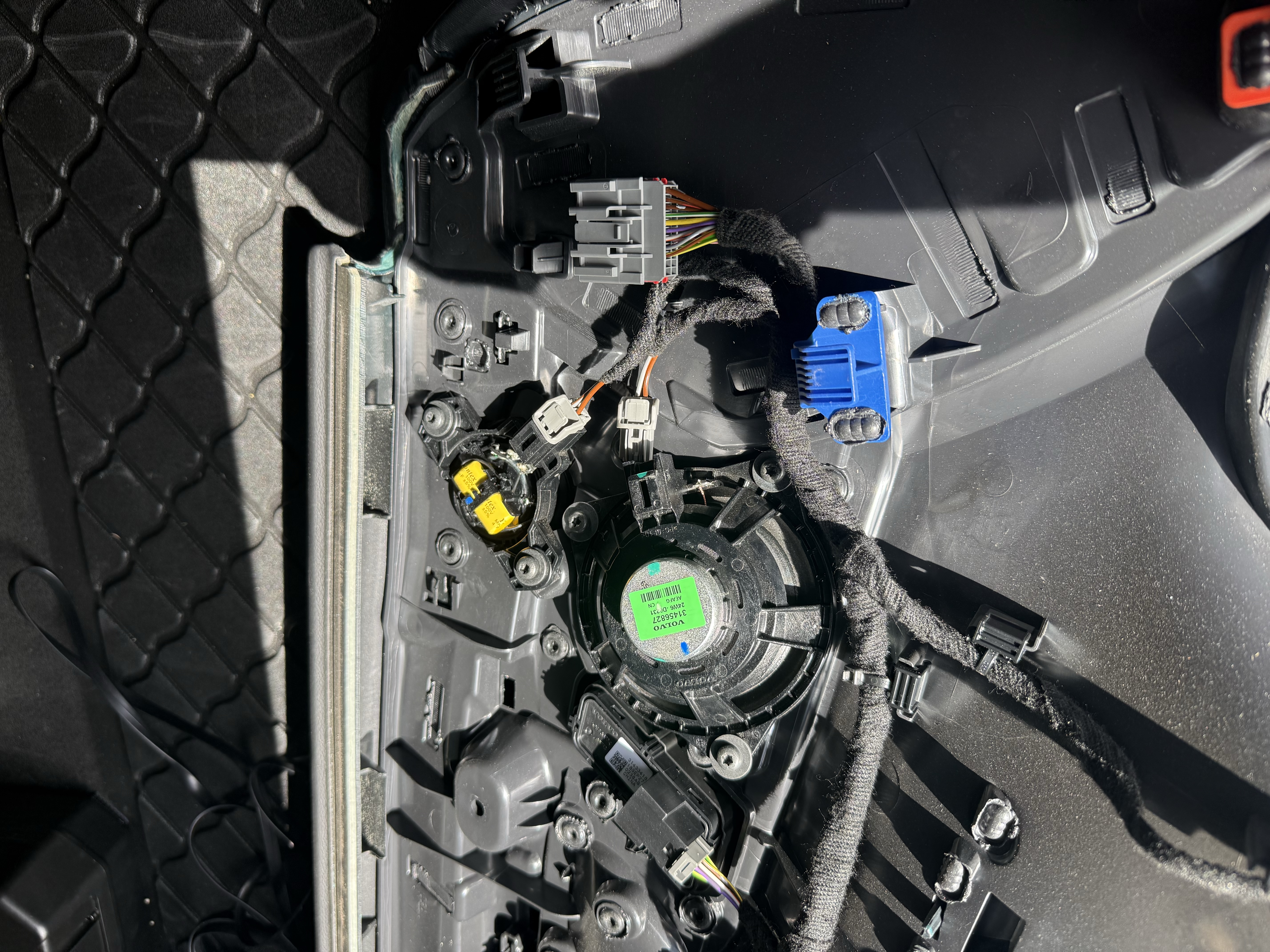
- Three speakers in each front door: woofer, midrange and tweeter
- Two speakers in each rear door: woofer and a small mid/high-frequency driver
- No parcel-shelf speakers
That gives the expected total of ten speakers.
The rear doors are particularly important because each rear door appears to receive a single full-range amplified channel. The woofer and smaller driver share that channel rather than having independent amplified outputs.
Why I tried this
The standard HP system wasn’t terrible. It could play loudly and the door woofers were surprisingly capable, but to my ears it lacked clarity and high-frequency detail. At high volume, particularly with bass-heavy music, vocals tended to disappear into the rest of the mix.
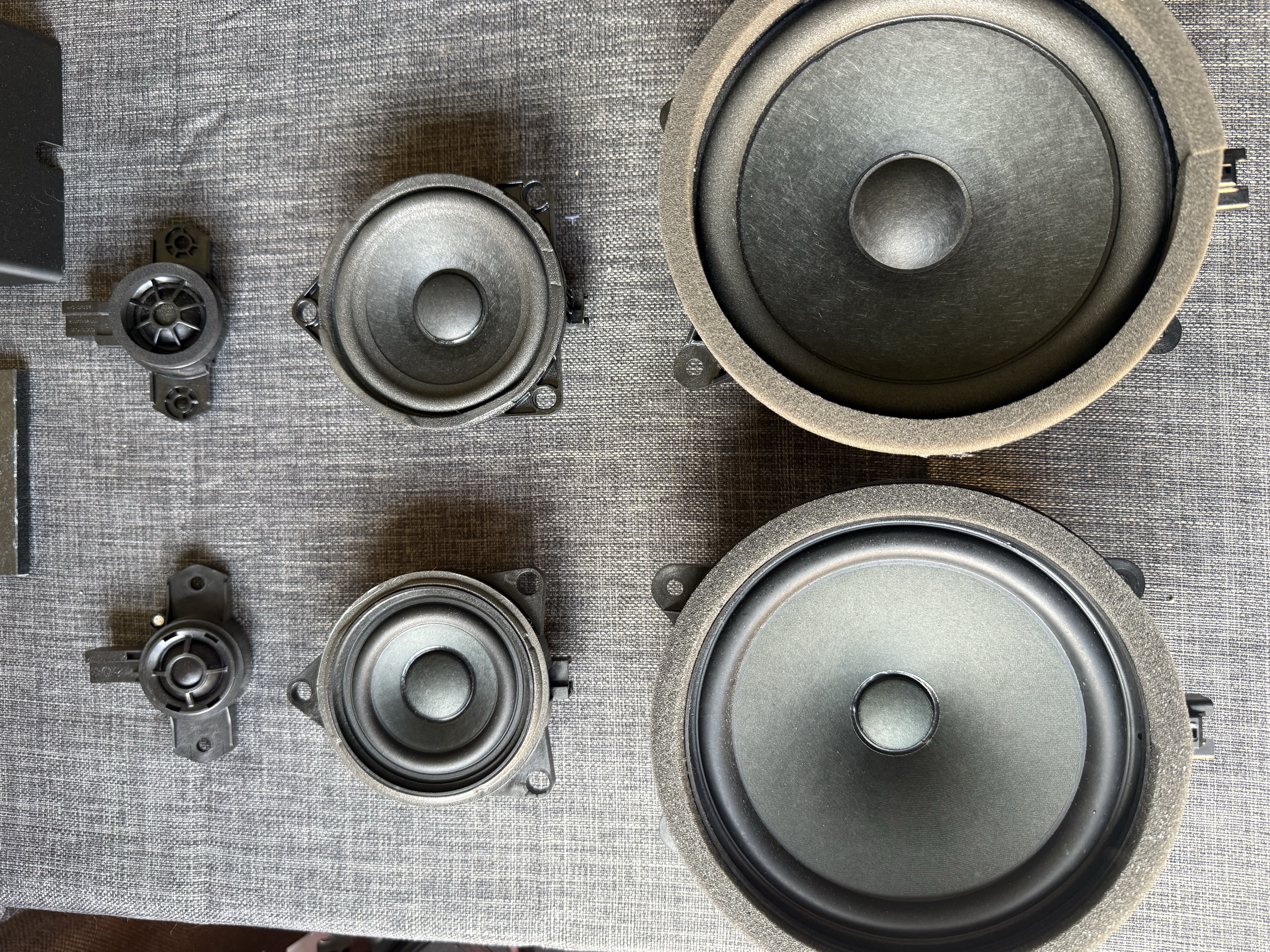
I bought a used collection of OEM Harman Kardon speakers removed from an XC90. The bundle contained considerably more than I needed, but many SPA Volvo speaker components are shared across models.
Before installing anything I measured every speaker with a multimeter and checked matched pairs individually.
Front speakers
The front doors turned out to be remarkably straightforward.
| Position | Original HP | HP measured DCR | Harman Kardon | HK measured DCR |
|---|---|---|---|---|
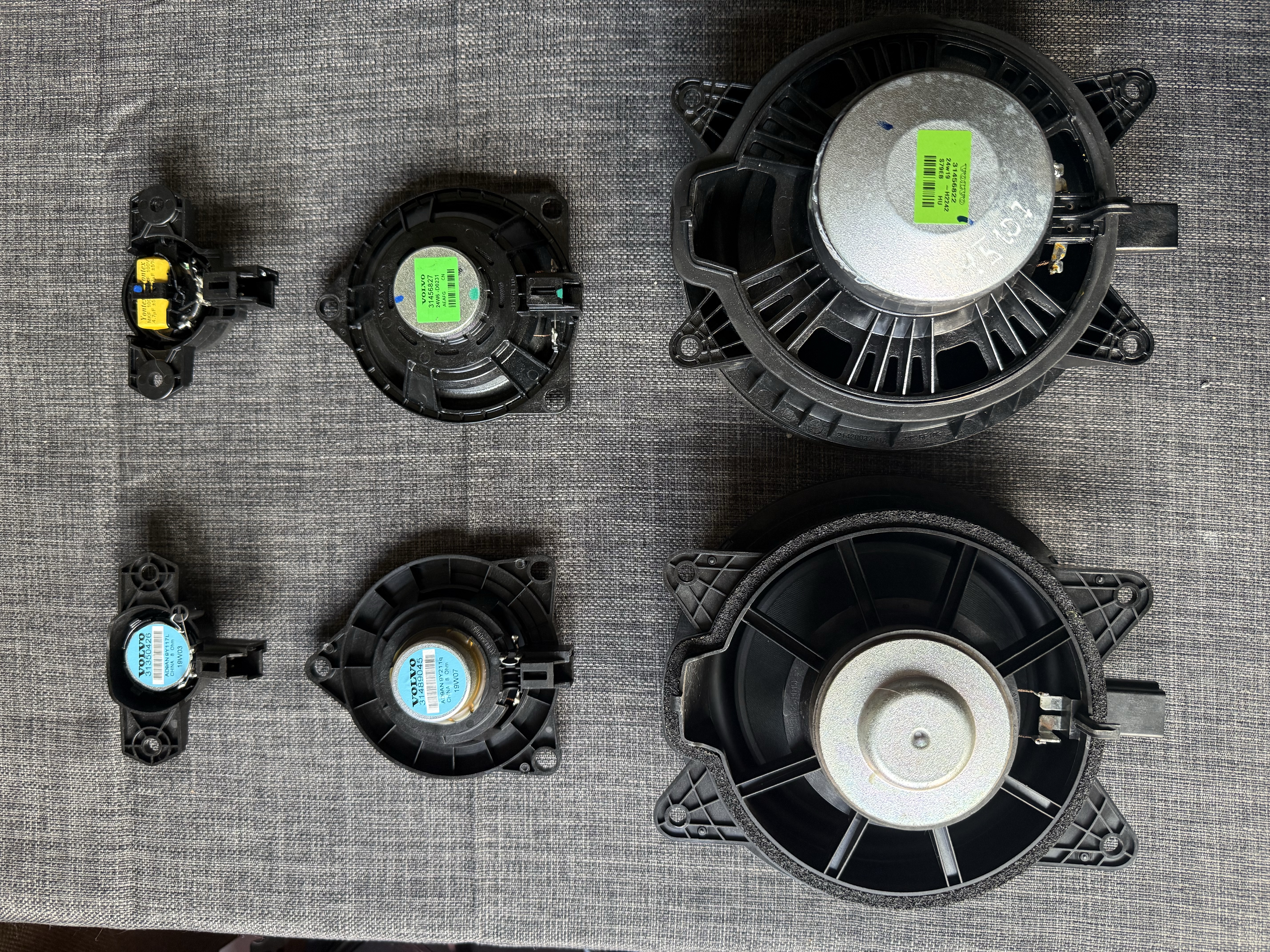
| Woofer | 31350425, marked 8 Ω | 8.7 Ω on healthy example* | 31456822 | 3.7 Ω |
| Midrange | 31489045, marked 8 Ω | 7.6 Ω | 31456827 | 5.2 Ω |
| Tweeter | 31350426, marked 8 Ω | 7.6–7.8 Ω | 31489121 | 12.2 Ω** |
* One of my original HP woofers produced unstable resistance readings between approximately 11–18 Ω and appears to have been faulty.
** The HK tweeter contains a 4.7 µF series capacitor, so the 12.2 Ω measurement was taken directly across the voice coil rather than through the connector.
All three HK speakers use the factory mounting locations and connectors. No drilling, riveting, cutting or adapter rings were required.
Removing an S90 door card is also surprisingly painless: four bolts, lift the card away and disconnect the main connector. Compared with many cars I’ve worked on, Volvo made these doors refreshingly serviceable.
Rear doors: an important difference
This is where the XC90 donor parts stopped being a straightforward swap.
There is an important architectural difference between the Volvo High Performance system and the Harman Kardon/Bowers & Wilkins systems.
On my MY19 S90 High Performance system, each rear door receives a single amplified audio channel. The woofer and smaller driver therefore share the same signal.
The Harman Kardon and Bowers & Wilkins systems use two amplified channels into each rear door, allowing the rear drivers to be driven and filtered independently.
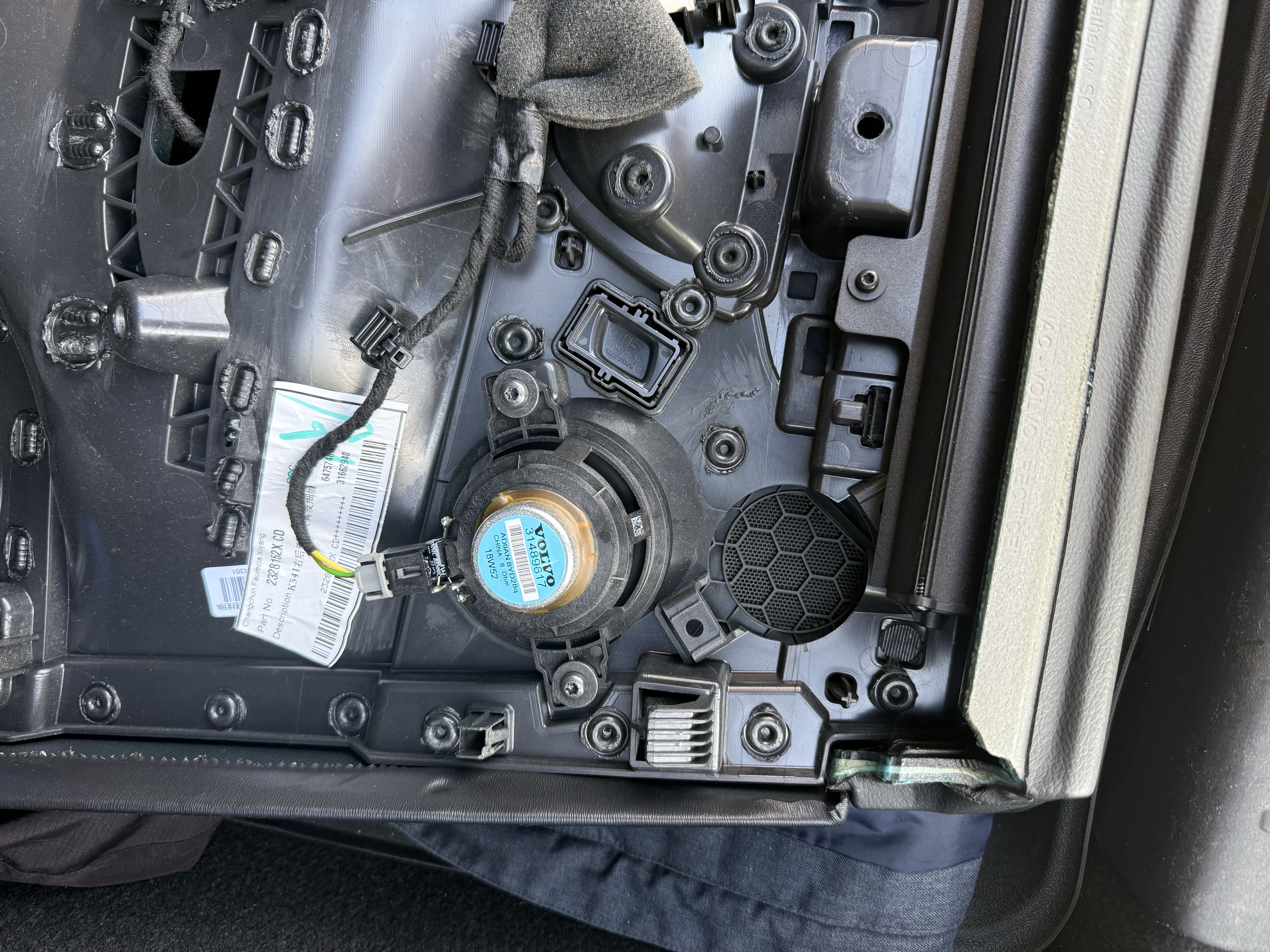
My S90 rear door contained:
- An 8 Ω woofer, measured at approximately 9.2 Ω DCR
- Volvo 31489617, an 8 Ω small midrange driver, measured at 7.6 Ω DCR
The interesting part is 31489617.
Although physically a midrange driver, it has a 2.2 µF capacitor wired in series with it. Because the HP rear door only receives one full-range amplified channel, this capacitor provides a passive high-pass filter, preventing the small driver from receiving the low-frequency content intended for the woofer.
In other words, the HP system effectively uses a woofer + midrange driver acting as the high-frequency/rear-fill speaker.
The Harman Kardon and Bowers & Wilkins systems instead use a woofer + tweeter arrangement in the rear doors, with the additional amplifier channel allowing the drivers to be controlled separately.
This distinction is important when considering speaker swaps: the drivers may physically fit and even use compatible connectors, but they are not necessarily electrically interchangeable.
The XC90 HK midrange does physically fit
My XC90 bundle contained:
31489254 — 3.7 Ω DCR
Physically this is remarkably close to the S90 HP 31489617. The mounting points, connector and overall dimensions match, and it can physically be installed in the same position.
However, 31489254 does not have the 2.2 µF passive high-pass capacitor fitted to my HP driver.
That makes sense if it originates from an HK installation where the amplifier provides independently filtered channels.
Connecting the ~4 Ω HK mid directly in parallel with the ~4 Ω HK woofer on the S90 HP’s single full-range rear channel would therefore be a very different electrical configuration. It would also expose the small HK driver to frequencies it may not be intended to reproduce.
I decided not to do this.
Interestingly, Volvo parts catalogues list 31489255 as an S90 High Performance Pro/Harman Kardon rear tweeter. This further suggests that the HP and HK rear-door architectures should not be assumed to be interchangeable simply because the connectors and mounting positions fit.
My final configuration
I ended up using:
| Location | Configuration |
|---|---|
| Front left | HK 31456822 woofer + 31456827 mid + 31489121 tweeter |
| Front right | HK 31456822 woofer + 31456827 mid + 31489121 tweeter |
| Rear left | HK 31489120 woofer + original HP 31489617 high-passed mid/fill |
| Rear right | HK 31489120 woofer + original HP 31489617 high-passed mid/fill |
| Subwoofer | Pioneer TS-WX400DA active subwoofer |
This isn’t a complete Harman Kardon retrofit. It is deliberately a hybrid configuration which retains the HP rear fill drivers and their factory passive filtering.
For my purposes this is preferable to modifying the door wiring or designing a crossover simply to make the HK-labelled mids fit.
Other speakers from the XC90 bundle
The donor bundle contained several components which weren’t useful for this S90 installation.
| Part number | Description / finding |
|---|---|
| 31489122 | HK centre dashboard speaker, 5.2 Ω DCR |
| 31489254 | XC90 HK rear midrange, 3.7 Ω; physically fits S90 rear door but not used for the electrical reasons above |
| 31489256 | HK/High Performance Pro roof speakers, 3.6 Ω |
| 31456258 | XC90 cargo-area High Performance subwoofer, 3.6 Ω |
I also experimented with the HK centre speaker. Although a physical centre-speaker retrofit is possible, the centre output on my HP amplifier produced effectively no usable audio. A proper centre-channel retrofit therefore appears to require more than simply adding the speaker.
How does it sound?
Audio is subjective, and this is not a controlled laboratory comparison.
With that caveat, the difference in my car is enormous.
The most noticeable improvement is clarity. Vocals which previously felt buried in the mix are now extremely clear, and the perceived soundstage has moved upwards: vocals often appear to come from around windscreen height rather than obviously from the door speakers.
The HK tweeters produce considerably more high-frequency energy than the original HP speakers. During initial testing with only one front door converted, the HK side actually sounded excessively bright. With both front doors converted and the factory EQ adjusted, however, the system became much better balanced.
EDM in particular sounds excellent. Bass from the door woofers and Pioneer sub remains strong while vocals and high-frequency detail stay clearly separated.
Another unexpected difference is usable volume. Previously I would sometimes run the HP system at or near maximum volume on the motorway. With the HK speakers installed, approximately two-thirds volume is already uncomfortably loud for me while remaining clear.
For my preferences, it now sounds much more like the audio system I would have expected the S90 to have from the factory.
A warning about impedance
This is the bit I would not ignore.
The original HP speakers are predominantly 8 Ω drivers. Several of the HK replacements measure approximately 4 Ω.
At a given output voltage, a lower impedance can require substantially more current from an amplifier. I have not found a trustworthy published minimum-load specification for the particular Volvo HP amplifier fitted to my car.
There are reports from other SPA Volvo owners successfully running lower-impedance replacement or HK speakers from the factory HP amplifier, and my amplifier has so far behaved normally. During initial testing it did not enter protection, distort or become noticeably hot.
That is empirical observation, not proof of long-term electrical safety.
I am therefore not claiming that fitting 4 Ω HK speakers to an amplifier supplied with 8 Ω speakers is safe. Anyone reproducing this modification does so at their own risk.
Long-term plan: DSP amplifier
My eventual plan is to install a Musway M6v4 DSP amplifier using a plug-and-play Volvo harness.
This would give me an amplifier designed to operate safely into lower impedances, along with proper DSP control over EQ, crossovers, time alignment and subwoofer integration.
Originally I considered the DSP amplifier necessary to make the system sound how I wanted. After installing the HK speakers, it has moved firmly into the category of a future refinement rather than an urgent upgrade.
For now, the factory amplifier is staying in place and I will monitor its behaviour over longer-term use.
Conclusions
The biggest lesson from this project is not to assume that SPA Volvo speaker systems are interchangeable simply because the speakers physically fit.
For my MY19 S90:
- The complete HK front speaker set is physically plug-and-play.
- HK rear woofers are physically plug-and-play.
- The MY19 HP rear doors contain a woofer and high-passed mid/fill driver rather than the parcel-shelf arrangement described in some earlier S90 material.
- The XC90 HK 31489254 mid physically fits the S90 rear door but is electrically configured differently and was therefore not used.
- The original HP rear fill driver works perfectly well alongside the HK woofer.
- The impedance difference between HP and HK speakers means this should not be treated as a factory-approved retrofit.
Most importantly, for my own listening preferences the result has been considerably better than expected.
It still looks completely factory, required no irreversible modifications, and if I hadn’t installed it myself I would simply assume the car had come with a very good OEM audio system.
That’s exactly the result I wanted.
Loom reference
I have also looked into making a short intermediate loom so the XC90 HK mids (31489254) could be used in the S90 HP rear doors without cutting the factory wiring.
The idea is a plug-and-play adapter: factory rear-door speaker connector → a small loom containing a series capacitor/crossover → the HK mid connector. That would reproduce the high-pass filtering currently provided by the 2.2 µF capacitor on the original HP 31489617, which the HK mid does not have.
I have not built this yet. It remains a potential next step rather than something I have fitted or validated in the car.
The Volvo speaker connectors I have identified for that loom are Yazaki:
| Role | Part number |
|---|---|
| Female connector | 7282-6443-40 |
| Male connector | 7283-6443-40 |
| Female terminal | 7116-4100-02 |
| Male terminal | 7114-4100-02 |
If I do make the adapter, those are the housing and terminal part numbers I would start from so the loom stays OEM-connector compatible and reversible.
Reference Photos